your circadian rhythm explained
Your body follows a carefully orchestrated 24-hour programme that influences everything from sleep and hormone production to skin repair and hydration. Discover how your Circadian Rhythm works, why it matters for sleep quality and overnight recovery, and how sleep products can help support your body's natural rhythms.
your body is programmed to follow a rhythm
Ever wondered why you naturally feel sleepy at night, more alert in the morning, or why your skin can look different depending on the time of day?
The answer lies in your Circadian Rhythm.
We all operate on a 24-hour cycle regulated by internal biological clocks. At the helm is the body's "master clock", located in the brain, which governs various physiological and behavioural functions including temperature, hormone release, metabolism, sleeping and cognitive function.
This clock is responsible for setting the programme for all of our bodily functions to be more efficient at certain times of the day.
At This Works, we have spent years working alongside circadian rhythm experts, sleep specialists and neuroscientists to better understand how these rhythms influence wellbeing, sleep quality and skin health. This includes collaboration with Professor Gaby Badre, a specialist in sleep medicine and clinical neurophysiology whose expertise focuses on chronobiological disorders.
Understanding your Circadian Rhythm is one of the most powerful ways to improve sleep quality, support overnight recovery and get more from your sleep products and evening rituals.
what exactly is the Circadian Rhythm?
Your Circadian Rhythm is your body's internal timing system.
At the centre of this system sits the suprachiasmatic nucleus (SCN), a small group of specialised nerve cells within the hypothalamus. Often referred to as the "master clock", it receives information from the eyes about light and darkness and uses these signals to coordinate biological processes throughout the body.¹
Think of it as the conductor of an orchestra. Every organ, tissue and cell has its own rhythm, but the master clock helps keep everything working together in sync.
When this system is working well, sleep, energy levels, digestion, mood and cognitive performance tend to feel balanced. When it becomes disrupted through stress, irregular routines, travel, shift work or excessive evening light exposure, sleep quality can suffer.
what does the Circadian Rhythm control?
chronotypes
Not everyone experiences the Circadian Rhythm in exactly the same way.
Chronotypes are variations in our natural sleep-wake preferences. Some people are naturally early risers, feeling most productive in the morning. Others feel more energised later in the day and find early starts more challenging.
Unlike mechanical clocks, our biological clocks are not perfectly synchronised. Each person's rhythm operates at a slightly different pace, influencing when they naturally feel awake or sleepy.
sleep and hormone production
Throughout the day, your Circadian Rhythm regulates the release of hormones that influence alertness and sleep.
Morning light helps stimulate cortisol production, supporting focus and energy. As evening approaches and light levels decrease, melatonin production increases, helping prepare the body for sleep.²
This natural cycle is one reason why regular bedtimes and wake times can have such a powerful effect on sleep quality.
skin repair
Late at night and during the early hours of the morning, epidermal stem cells create new skin cells, replacing older ones.
This renewal process takes place when the body is at rest and undisturbed, highlighting the importance of maintaining a healthy sleep-wake schedule.
Beautiful skin starts with a good night's sleep.
It is during this overnight recovery phase that many of the skin's restorative processes are most active.
the skin barrier
The skin barrier is the body's first line of defence against environmental aggressors, pollutants and microorganisms.
Throughout the day, skin cells perform different activities to help protect and defend the body. This changing activity may help explain why skin can feel more sensitive at certain times of day.
skin hydration
Skin hydration follows a daily rhythm too.
The skin loses more water overnight through a process called trans-epidermal water loss, meaning dehydration levels often peak during sleep.³
This is one reason why nourishing evening skincare routines can play an important role in supporting overnight recovery.
skin sebum
Sebum is the skin's natural oil, responsible for lubricating and protecting both skin and hair.
Sebum production typically peaks around midday and reaches its lowest levels during the late evening and early morning, demonstrating yet another way the body's clock influences skin function.
your skin's daily rhythm
Interestingly, skin cells have their own clocks.
These cellular rhythms can function independently and respond to external influences including pollution, temperature, humidity and ultraviolet radiation.
Throughout a typical day, your skin's priorities shift.
night (11pm-6am): sleep and repair
During sleep:
- Repair mode is activated
- Melatonin production reaches its highest levels
- Anti-inflammatory and anti-stress hormones are released
- Skin dehydration levels peak due to trans-epidermal water loss
- Cellular renewal accelerates
This is when the skin is most receptive to supportive treatments and restorative rituals.
wake-up (6am-9am): correct and protect
By morning:
- Skin may feel dehydrated following overnight water loss
- Skin barrier function can be temporarily compromised
- DNA repair activity slows
- Skin becomes more susceptible to environmental stressors and UV exposure
daytime (9am-6pm): boost and defend
During the day:
- Hydration levels begin to increase
- Sebum production peaks
- Protective functions become the priority
- Skin requires support against environmental aggressors
the role of sleep products in a healthy Circadian Rhythm
When people think about improving sleep quality, they often focus solely on bedtime itself.
In reality, sleep products work best when they become part of a consistent evening ritual that supports the body's natural rhythms.
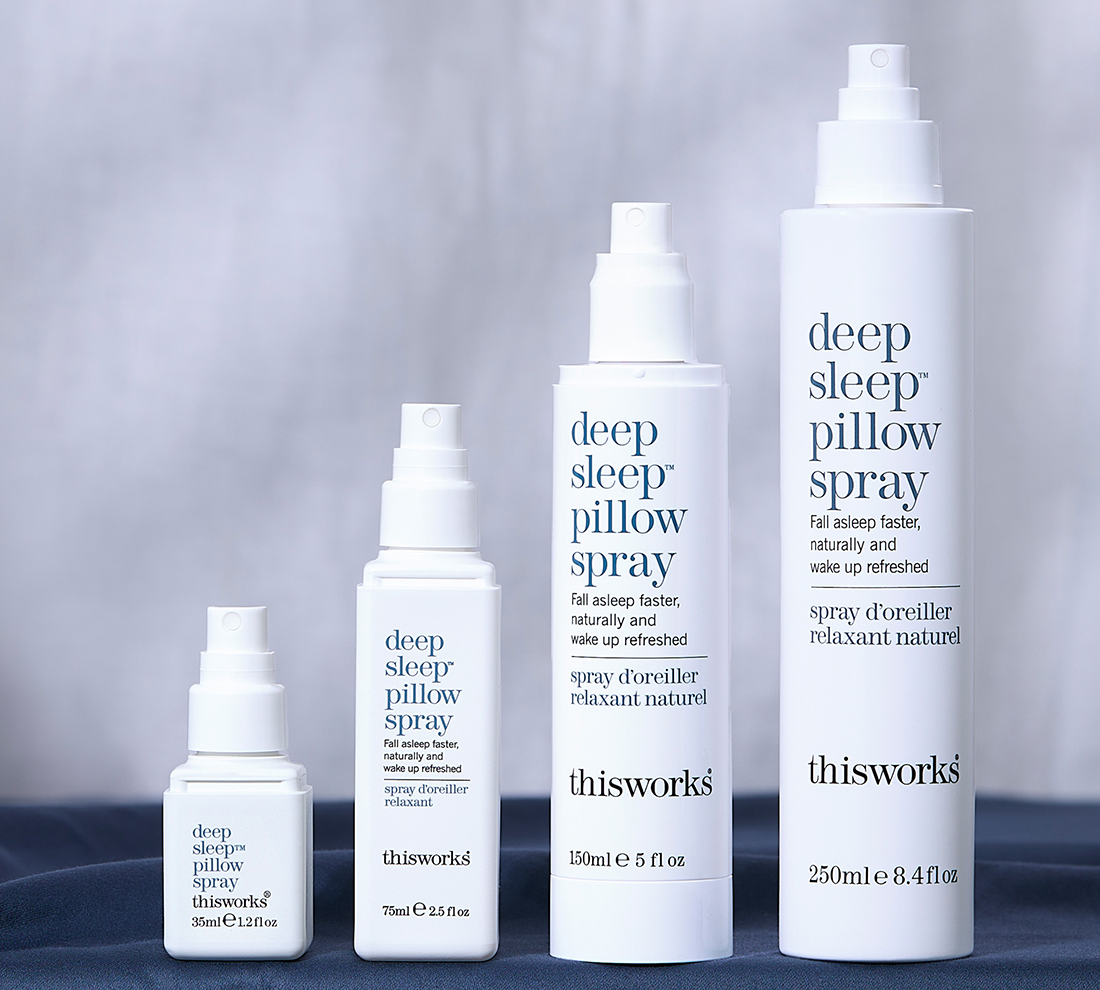
Sleep aids such as a pillow spray, sleep spray or lavender pillow spray can help create sensory cues that signal to the brain that it is time to move from daytime alertness into evening calm.
Since 2004, This Works has worked alongside neuroscientists and sleep experts to better understand how fragrance, behaviour and the nervous system interact to influence sleep quality.
Our award-winning deep sleep pillow spray combines Lavender, Camomile and Vetivert in the Deep Sleep Functional Fragrance, designed to help support relaxation as part of a bedtime ritual.
In a study of 100 subjects and 100 ex-prescription users, 89% fell asleep faster than usual, 98% felt more refreshed in the morning and 97% slept better after using products from the Deep Sleep collection.*
Whether you refer to it as a sleep spray, sleeping spray, deep sleep spray or lavender pillow spray, consistency is often the key to creating a successful bedtime habit.
how sleep products can support your Circadian Rhythm
Supporting your Circadian Rhythm does not require a complete lifestyle overhaul.
Small changes can make a meaningful difference.
seek natural daylight early
Morning light helps reinforce healthy Circadian Rhythm timing and supports the body's natural sleep-wake cycle.⁴
maintain a regular sleep schedule
Going to bed and waking at similar times each day helps keep your biological clocks aligned.
create a consistent wind-down ritual
A warm bath with deep sleep bath oil, followed by deep sleep beauty oil and a final spritz of deep sleep pillow spray, can help create a sequence of calming signals that support relaxation and overnight recovery.
use sleep aids consistently
Sleep aids work best when they become part of a repeated routine rather than a one-off solution.
The brain responds strongly to familiar sensory cues, making products such as a pillow spray or sleep spray valuable additions to a nightly ritual.
reduce evening light exposure
Limiting bright light and screen exposure in the evening may help support the body's natural melatonin production.
why sleep remains the foundation of wellbeing
When people search for sleep products, sleep aids or the best sleep spray, they are often looking for a better night's sleep.
But restorative sleep influences much more than how rested you feel in the morning.
It supports cognitive performance, skin health, emotional wellbeing and overnight recovery.
Whether you're exploring sleep products to improve your bedtime routine, looking for natural sleep aids, or searching for the best sleep spray to complement your evening ritual, understanding your Circadian Rhythm is the first step.
Your body clock is already working hard behind the scenes.
The more you work with it, the easier it becomes to enjoy deeper sleep, healthier routines and more restorative nights.
references
- Foster RG. Sleep, circadian rhythms and health. Interface Focus. 2020;10(3):20190098.
- Logan RW, McClung CA. Rhythms of life: circadian disruption and brain disorders across the lifespan. Nature Reviews Neuroscience. 2019;20(1):49-65.
- Czeisler CA, Gooley JJ. Sleep and circadian rhythms in humans. Cold Spring Harbor Symposia on Quantitative Biology. 2007;72:579-597.
- Wright KP Jr, McHill AW, Birks BR, Griffin BR, Rusterholz T, Chinoy ED. Entrainment of the human circadian clock to the natural light-dark cycle. Current Biology. 2013;23(16):1554-1558.
study reference
*Deep Sleep collection panel tested results: 89% fell asleep faster than usual, 98% felt more refreshed in the morning and 97% slept better. In a study of 100 subjects and 100 ex-prescription users.
sleep hygiene: related posts
 sleep hygienecan you train your brain for bedtime?Can a familiar scent become a signal that it is time to sleep? Professor Gaby Badre explores the connection between scent, the brain and nervous system — and how repeated sensory cues may help support the transition from daytime alertness...read post
 sleep hygienewhen the brain won’t switch off: understanding chronic insomniaWhy can sleep remain difficult long after the original trigger has passed? Professor Gaby Badre explores the science of chronic insomnia, the hyperarousal that can keep the brain alert at night, and how the brain can be retrained for sleep.read post
 red lightRed Magazine features Dr Anna Persaud’s story: can we use our senses to make us feel safe?In Red, Dr Anna Persaud shares her personal experience of anxiety and how neuroscience, therapy and sensory rituals helped her understand her nervous system – and find new ways to switch off.read post
 skincare concernsin transit no traces featured in British Vogue: the cleansing essential for hard waterOur in transit no traces cleansing pads have been featured in British Vogue as a Vogue-approved skincare solution for hard water, helping remove lingering residue without the need to rinse.read post
 fragranceOwn Time Eau de Parfum featured in Refinery29: the connection between scent and wellbeingOwn Time Eau de Parfum features in a personal Refinery29 exploration of fragrance, self-care and endometriosis, with our CEO Dr Anna Persaud sharing the science behind scent, memory and emotion.read post
 bodycare concernssummer skin recoverySummer may leave skin dry, dull and depleted, but recovery is about more than restoring your glow. Discover how intelligent skincare, technology and the power of touch can help replenish post-summer skin while reconnecting you with the body you live...read post
 sleep hygienethe science of switching off – a Doctor’s perspectiveDr Lana Gault explores the science behind switching off, from nervous system regulation and circadian rhythms to the simple, repeatable cues that can help prepare the body and brain for sleep.read post
 sleep hygienethe science of switching offYou don’t just have a sleep problem, you have a switching off problem. Sensory care rituals and neuroscience-informed products designed to support the transition into sleep and recovery.read post

