









the body-mind connection, Professor Gaby Badre on how the body influences the brain
Professor Gaby Badre explores the science of the body-mind connection, examining how signals travelling from the body to the brain influence emotional regulation, stress, cognition and wellbeing.
The concept of a unified body and mind is well recognised today. The relationship between body and mind is a dynamic, bidirectional flow of information through the nervous system. While the brain’s capacity to affect peripheral organs has long been established, the reverse pathway, from body to brain, is less widely understood.
The transmission of sensory information from bodily tissues and organs to the central nervous system (CNS) and autonomic nervous system (ANS) is now recognised as a critical influence on mood, cognition, immune regulation and psychological resilience.
polyvagal theory and the body-mind connection
Polyvagal theory proposes that the vagus nerve helps regulate autonomic state, emotional balance and social engagement. It offers one way of understanding the links between physiological state, perceived safety, relationships and self-regulation.
At the same time, some aspects of the theory remain debated. Its practical value therefore should not depend on accepting all of its claims.
The broader and more secure point is that signals from the body continuously influence autonomic state, emotion and mental readiness. This is why interventions such as touch, food, exercise, breathing, posture, sleep regulation and sensory environment can affect both mind and body.
Whether described through polyvagal theory or through interoception and autonomic neuroscience, the conclusion is similar, acting on the body can change brain state because the brain is constantly informed by the body.
interoception
Interoception refers to the sensing, interpretation and integration of signals originating from within the body. These signals include mechanical stretch, temperature, pressure, pain, visceral distention, nutrient-related signals, immune activity, heartbeats, airway inflation and chemical changes such as oxygen, carbon dioxide and osmolarity.
They reach the brain through several afferent systems and are represented in distributed networks involving the brainstem, thalamus, hypothalamus, insula, anterior cingulate cortex, amygdala and prefrontal regions.
Mood, vigilance, decision-making and the sense of wellbeing do not arise solely from “top-down” cognition. They are partly constructed from ongoing “bottom-up” information about the body’s internal state.
When afferent signalling is coherent and predictable, regulation is easier. When it is noisy, inflammatory, metabolically unstable, painful, sleep-disrupted or conflicting, mental and autonomic regulation become more costly.
When interoceptive signalling is disrupted, it can lead to alexithymia, difficulty identifying emotions, anxiety disorders and depression. Conversely, deliberately modulating these signals through touch, diet or electrical stimulation offers a novel therapeutic avenue.

neuroanatomy and the physiological basis of the body-mind interface
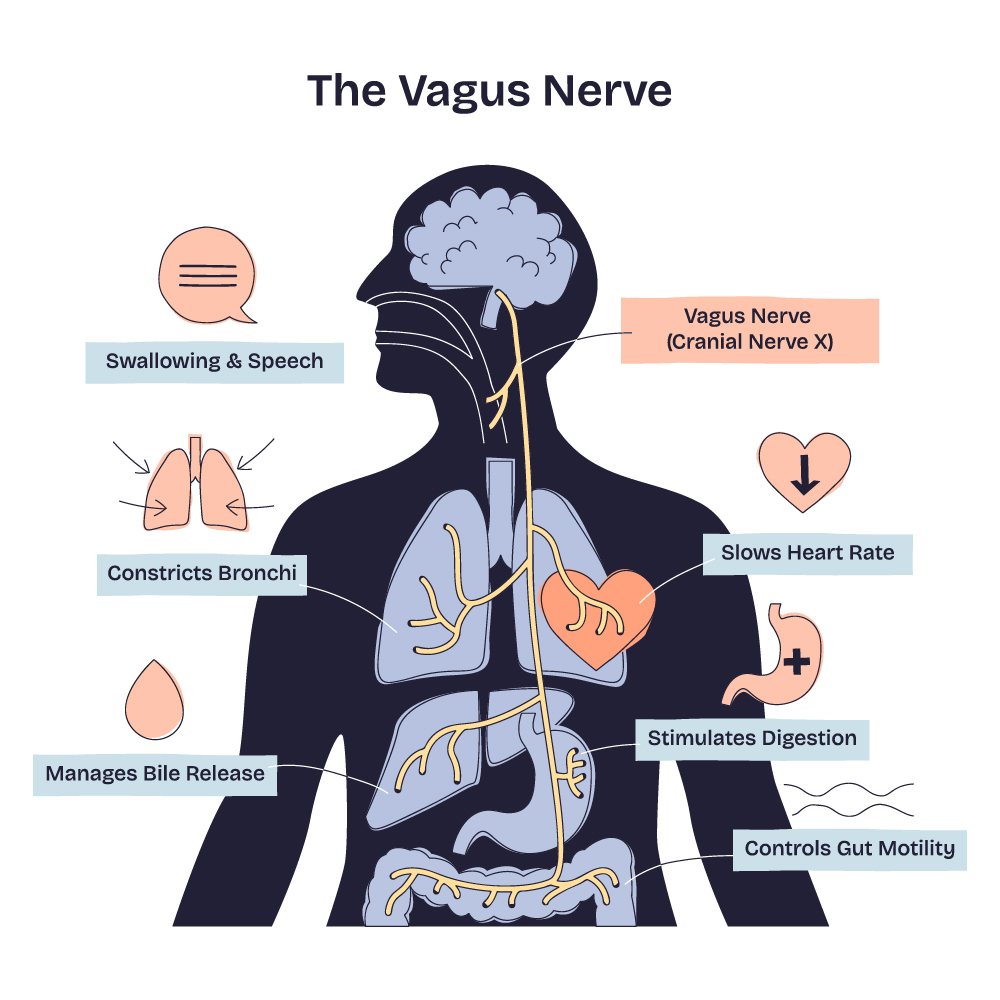
The vagus nerve is the main communication route between the internal organs and the brain. As a central part of the parasympathetic nervous system, it supports rest, recovery and physiological balance.
Most of its fibres are sensory, carrying information from the gut, heart, lungs and liver to the brainstem. There, these signals are integrated and relayed to regions involved in arousal, emotion and automatic regulation of the body.
Through this network, vagal signals help shape breathing, cardiovascular function, digestion, appetite, nausea, inflammation and emotional state.
Signals from the gut are particularly important, since a meal, stomach stretching, intestinal nutrients or microbial products can all modify the messages sent to the brain. In this way, changes in the digestive system can influence mood and alertness very rapidly, often before any conscious thought occurs.
the enteric nervous system, the “second brain”
The enteric nervous system (ENS), often called the “second brain”, is a complex network of more than 500 million nerve cells embedded in the wall of the gut. Although it can work independently to control many digestive functions, it is also in constant communication with the central nervous system.
This communication takes place through several pathways, especially the vagus nerve, spinal sensory pathways and stress-related systems such as the hypothalamic-pituitary-adrenal (HPA) axis. As a result, signals coming from the gut can influence not only digestion, but also mood, anxiety and even aspects of social thinking.
The gut also plays an important chemical role. About 90% of the body’s serotonin is produced there, helping explain why gut function can affect emotional and mental states.
The gut microbiome further strengthens this gut-brain connection. Substances produced by gut microbes, such as short-chain fatty acids, tryptophan-derived compounds and precursors of GABA, can influence vagal activity, inflammation in the nervous system and the body’s stress response.
Within the gut itself, nerve cells can detect stretching, pressure and chemical changes. They then trigger automatic responses that help regulate digestion, feelings of fullness and reward.
Recent research also shows that the gut can sense nutrients and send information to the brain about calorie content and the balance of carbohydrates, fats and proteins.
nutrition and the gut-brain axis
Gut-derived afferent activity is particularly relevant because meal ingestion, gastric distension, intestinal nutrients and microbial metabolites can all alter signalling to the brain.
Food shapes communication between the gut and the brain. What we eat, how often we eat and how regular our meals are can influence mood, stress, mental clarity and overall balance.
This occurs through several pathways simultaneously, including digestion, blood sugar changes, hormones, immune signals, the gut microbiome and nerve signals travelling from the gut to the brain.
A varied, fibre-rich diet, especially one based on plant foods, helps support a healthy gut microbiome. In turn, gut bacteria produce substances that help protect the gut barrier, reduce inflammation and support healthy signalling to the brain.
Some studies suggest that Mediterranean-style eating patterns may improve depressive symptoms.
Fermented foods such as yoghurt, kefir, kimchi and sauerkraut may increase microbial diversity and lower inflammation. Omega-3 fats, found in oily fish and flaxseed, may also support brain function and emotional wellbeing.
By contrast, diets high in ultra-processed foods, refined sugar and poor-quality fats may disturb gut balance, increase inflammation and weaken gut-brain communication.
Meal timing also matters. Regular eating patterns appear to support more stable body-to-brain signalling, while fasting may, in some cases, improve flexibility in energy use, reduce inflammation and support brain function.
The broader point, however, is not that single foods act like a treatment, but that stable and good-quality nutrition creates better conditions for regulation. Eating is not just about calories, it is also a biological signal that affects how we feel and function.

touch, breathing and movement
The skin is the body’s largest sensory organ and a major source of afferent input. Touch can strongly influence how calm, safe or tense we feel.
Gentle, slow touch appears to activate specific pathways in the skin and brain that help the body shift towards a more settled state. This kind of touch has been linked to lower heart rate, lower blood pressure, reduced stress hormones and increased activity in systems involved in rest, recovery and social bonding.
Massage is one of the best-studied examples and has been associated with reduced anxiety and low mood, sometimes even after a single session.
Other forms of touch, including self-soothing gestures such as placing a hand on the chest or abdomen, may also reduce stress and help regulate emotional state.
Breathing is unique because it works both automatically and under conscious control. This makes it a simple and direct way to influence how the body and mind respond to stress.
Slow, steady breathing can help the body shift towards a calmer and more flexible state. It may reduce stress and anxiety, improve emotional balance and support better coordination between breathing, heart rhythm and the nervous system.
Movement also changes the signals sent from the body to the brain. Muscle activity, breathing, heart function and body temperature all shift during exercise, providing the brain with updated information about the body’s condition.
Over time, this may improve stress regulation and recovery. Moderate, consistent and sustainable movement may be especially beneficial because it strengthens body-brain communication without overloading the system.

temperature, sensory stimulation and vagus nerve stimulation
Thermal stimulation is an important but often overlooked influence on the connection between body and mind.
Exposure to cold, such as cold-water immersion or outdoor cold-water swimming, activates temperature and pain receptors, sending strong signals to the brainstem and hypothalamus.
Short-term cold exposure also produces a rise in stress-related chemical messengers, particularly noradrenaline, together with the release of endorphins and dopamine. These effects may help explain why cold-water swimming is often associated with improved mood.
Heat exposure, by contrast, as in sauna bathing, first activates the body and then tends to promote a rebound towards relaxation. It has also been linked to the release of substances associated with wellbeing and recovery.
Sound, smell and visual surroundings may also influence autonomic state. Time spent in natural environments has been linked to lower cortisol levels, reduced sympathetic activation and improved mood.
Direct stimulation of vagal pathways, especially through non-invasive stimulation at the ear, has also become an area of growing clinical interest. Recent studies suggest potential benefits in conditions including chronic insomnia, although research is still developing.
Even so, the broader principle remains important, peripheral stimulation can modify central regulation by acting through body-to-brain pathways.

practical and integrative approaches
Mental and autonomic regulation can be improved not only through cognitive or psychological approaches, but also through simple interventions that act on the body itself.
These include slow breathing, healthy and regular nutrition, regular physical activity, thermal exposure and affective touch, all of which may help regulate brain and autonomic function in accessible and low-risk ways.
From this perspective, care can become more integrative, particularly in patients with anxiety, depression, chronic pain or trauma.
Some individuals respond more readily to body-based methods such as movement or thermal exposure, whereas others may find it easier to begin with breathing or attentional practices.
Combining approaches that target different afferent pathways may offer broader and more durable effects than any single intervention alone.
What these methods share is that they influence the signals travelling from the body to the brain. This may be the main physiological pathway through which they help shape emotional and autonomic states.
conclusion
The body and brain are linked through continuous two-way signalling, with afferent pathways playing a central role in emotional and autonomic regulation.
This perspective supports a more embodied and integrative understanding of health and wellbeing.

references
Farb N et al. Front Psychol. 2015.
Lazzarelli A et al. Behav Sci. 2024.
Chen W et al. Trends in Neurosciences. 2021.
Nikolla E et al. FASEB J. 2025.
Seth AK, Friston KJ. Philos Trans R Soc Lond B Biol Sci. 2016.
McGlone F et al. Neuron. 2014.
Décarie-Spain L et al. Semin Cell Dev Biol. 2024.
Onimus O et al. Neurobiol Dis. 2024.
Quadt L et al. Ann N Y Acad Sci. 2018.
Critchley HD, Garfinkel SN. Curr Opin Psychol. 2017.
Zaccaro A et al. Front Hum Neurosci. 2018.
Kandola A et al. Front Hum Neurosci. 2016.
related posts
 bodycare concernssummer skin recoverySummer may leave skin dry, dull and depleted, but recovery is about more than restoring your glow. Discover how intelligent skincare, technology and the power of touch can help replenish post-summer skin while reconnecting you with the body you live...read post
 sleep hygienethe science of switching off – a Doctor’s perspectiveDr Lana Gault explores the science behind switching off, from nervous system regulation and circadian rhythms to the simple, repeatable cues that can help prepare the body and brain for sleep.read post
 sleep hygienethe science of switching offYou don’t just have a sleep problem, you have a switching off problem. Sensory care rituals and neuroscience-informed products designed to support the transition into sleep and recovery.read post
 fragranceOwn Time Eau de Parfum wins an Oprah Daily Beauty O-ward for best bedtime scentOur Own Time Eau de Parfum has been named Best Bedtime Scent in the Oprah Daily Beauty O-wards, celebrating the very best in beauty and wellbeing.read post
 sleep hygienethe science of switching off: Dr Anna Persaud in the Financial TimesDr Anna Persaud, CEO of This Works, joins the Financial Times’ Brains of Wellbeing + Beauty series to explore what it really takes to get a better night’s sleep.read post
 joywellness weekender: five days to reconnect with your nervous systemJoin us this August Bank Holiday for five days of neuroscience-led rituals designed to help you regulate your nervous system through sensory care. Together we'll explore aroma, light, touch, movement and mindful self-assessment, discovering how small daily rituals can create...read post
 joythe wellness gift guide: how to choose something worth givingFinding the perfect gift isn't about spending more—it's about choosing something thoughtful. Whether you're shopping for wellness gift sets, skincare gift sets, relaxation gifts or sleep gifts for someone special, discover how to choose gifts that encourage rest, relaxation and...read post
 joywellness gifts for new mums: what they actually needThe best gifts for new mums aren't always the biggest—they're the ones that help her feel cared for. Whether you're shopping for a baby shower, celebrating a new arrival or simply letting someone know you're thinking of them, discover thoughtful...read post

